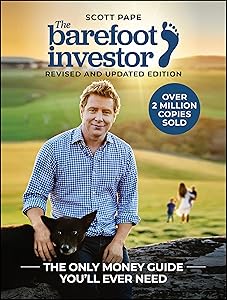
The Barefoot Investor (Classic Edition)

Our recommendation

The money book Australians keep coming back to.

The Barefoot Investor (Classic Edition)

$19.00 ★★★★★ 4.8 (8.2K reviews)
Check price on Amazon →

Article

The Power of Compound Interest: Why Starting Early Changes Everything

2026-04-12 · 6 min read

The Power of Compound Interest: Why Starting Early Changes Everything

What Is Compound Interest?

Compound interest is earning interest on your interest. When you invest money, you earn a return. Next period, you earn a return on your original investment plus on last period's return. The effect is exponential — it starts slowly, then accelerates, then becomes overwhelming.

Albert Einstein is often (probably incorrectly) credited with calling compound interest the eighth wonder of the world. Accurate attribution aside, the principle is genuinely remarkable, and the mathematics are unforgiving in both directions — it builds wealth over time and it destroys financial health when it's working against you through debt.

Try the numbers yourself with our Compound Interest Calculator.

A Simple Example

Imagine two Australians, Alex and Jordan. Both invest $5,000 per year and earn 7% annually (roughly the long-run return from a diversified share portfolio).

  • Alex starts at age 25 and invests for 40 years until age 65
  • Jordan starts at age 35 and invests for 30 years until age 65

Alex contributes $200,000 total (40 × $5,000). Jordan contributes $150,000 total (30 × $5,000). Alex contributed $50,000 more.

At retirement:

  • Alex's portfolio: approximately $1,068,000
  • Jordan's portfolio: approximately $472,000

Alex ends up with more than double Jordan's balance by contributing for 10 extra years. The extra $50,000 in contributions produced an extra $546,000 in wealth. That's the power of time in the market.

The Rule of 72

A useful mental shortcut: divide 72 by your expected annual return to find how many years it takes to double your money.

  • At 4%: 72 ÷ 4 = 18 years to double
  • At 7%: 72 ÷ 7 = ~10 years to double
  • At 10%: 72 ÷ 10 = 7.2 years to double

A 30-year-old with $50,000 at 7% will see that become $100,000 by 40, $200,000 by 50, and $400,000 by 60 — without adding another cent. That's three doublings in 30 years.

Compounding Inside Superannuation

For Australians, superannuation is one of the most powerful compound interest vehicles available — it's tax-advantaged, professionally managed, and has a decades-long time horizon. The compulsory Super Guarantee means most workers are already participating, but few think about it in compounding terms.

Use the Super Balance Growth Calculator to project your super balance at retirement based on your current balance, salary, and contribution rate. Increase the contribution rate by even 2–3% and the difference at retirement is typically six figures.

Frequency of Compounding Matters

Compounding can occur annually, monthly, weekly, or daily. The more frequently interest compounds, the faster your balance grows. Most savings accounts compound monthly or daily. Investment returns (shares) are typically modelled annually, but dividend reinvestment and price growth compound continuously in practice.

Compounding Working Against You: Debt

The same maths that builds wealth through investing destroys it through high-interest debt. A credit card balance at 20% interest compounds just as relentlessly. $10,000 in credit card debt with minimum payments can take 20+ years to clear and cost you more than double the original balance in interest.

Use the Savings Goal Calculator to plan how to build savings, and treat high-interest debt as the mathematical inverse of investing — eliminating it is the guaranteed equivalent of earning the debt's interest rate as a return.

Practical Steps to Harness Compounding

  1. Start now, not later. Time is the variable that matters most. A 5-year head start is worth more than a 1% higher return over a full investment lifetime.
  2. Automate contributions. Regular, automatic investments prevent the behavioural tendency to time the market or miss months.
  3. Reinvest dividends. Don't take investment income as cash — reinvest it so it compounds alongside your capital.
  4. Minimise fees. A 1% annual management fee on an investment returning 7% costs you roughly 14% of your final balance over 30 years. Low-cost index funds are a common solution.
  5. Don't interrupt compounding. Withdrawing from investments resets the compounding clock on that money.

For a thorough, Australian-focused guide to building wealth through long-term investing, investing books on Amazon AU cover portfolio construction, superannuation strategy, and the psychology of staying the course through market volatility.

Common Mistakes That Sabotage Your Compound Returns

Understanding compound interest in theory is one thing. Capturing it in practice is another. Australians make several recurring errors that cost them hundreds of thousands in missed returns over a lifetime.

Waiting for the "right time" to invest. The most expensive mistake is delaying. People wait until they earn more, until the market drops, until they understand investing better. A 25-year-old who waits until 30 to start investing loses roughly 40% of their potential retirement balance, even if they invest the same total amount. The market's best days are unpredictable and often occur during volatile periods. Missing them while waiting on the sidelines is costly.

Stopping contributions during downturns. When markets fall 20% or 30%, the instinct is to stop investing or sell. This is precisely backwards. A market correction means your regular contributions buy more units at lower prices. When the market recovers (as it historically always has), those units appreciate. Dollar-cost averaging works best when you keep contributing through the tough periods.

Chasing high returns without understanding risk. A promised return of 12% or 15% sounds better than 7%, but higher returns usually mean higher risk, less liquidity, or higher fees. Speculative investments, crypto, or leveraged products might deliver short-term gains, but they interrupt the steady compounding that builds lasting wealth. The 7% to 8% long-run return from diversified Australian and global shares is boring, but it's reliable and it compounds predictably.

Ignoring fees and tax drag. A retail managed fund charging 1.5% annually versus a low-cost index fund at 0.15% doesn't sound like much. Over 30 years on a $300,000 balance, that 1.35% difference costs you more than $200,000 in lost compounding. Similarly, holding investments in taxable accounts when you could use super (taxed at 15% on earnings, or 0% in pension phase) means paying up to 47% tax on investment income if you're a high earner. Tax-effective structures let more of your return compound.

Withdrawing early from super. The COVID-19 early release scheme allowed eligible Australians to withdraw up to $20,000 from super. A 30-year-old who withdrew $20,000 and never replaced it lost approximately $150,000 to $200,000 in retirement savings by age 67, purely due to lost compounding. Super exists to compound over decades. Accessing it early is one of the most expensive financial decisions you can make.

Life-Stage Strategies: When to Prioritise Compounding

Compound interest works at any age, but the strategy shifts depending on where you are in life.

In Your 20s: Maximise Time, Minimise Perfection

Your greatest asset is time. A 23-year-old investing $200 per month until 67 at 7% ends up with approximately $650,000. Waiting until 33 and investing the same amount results in about $300,000. That extra decade is worth more than doubling your monthly contributions later.

Don't obsess over picking the perfect investment. A low-cost diversified fund (Australian shares, international shares, some bonds) is enough. The priority is building the habit and letting time do the work. Even if your super balance is only $15,000 at 25, that will likely become $200,000+ by retirement without you adding a cent beyond compulsory contributions.

In Your 30s and 40s: Increase Contributions and Optimise Tax

Your income is likely higher. You can afford to salary sacrifice into super, especially if you're earning above $45,000 (where the marginal tax rate hits 32.5% plus Medicare levy). Every dollar you salary sacrifice is taxed at 15% instead, and it compounds in a tax-advantaged environment for decades.

A 35-year-old earning $90,000 who salary sacrifices an extra $5,000 per year saves roughly $1,100 in tax annually (the difference between 34.5% and 15%). That $5,000 becomes approximately $8,000 by age 50 due to compounding. Do that every year and you add over $200,000 to your super balance by retirement.

This is also when you might have a mortgage. Paying it down is a guaranteed return equal to your interest rate (currently 6% to 7% for many). That competes with investing outside super. The optimal split depends on your risk tolerance, but paying off non-deductible debt (your home loan) and maxing concessional super contributions is a solid dual strategy.

In Your 50s and 60s: Protect What You've Built

You've likely accumulated significant wealth. Compounding is working hard for you, but a market crash now has less time to recover. Gradually shift to a more conservative asset allocation (more bonds, less shares) as you approach retirement.

Catch-up contributions matter. If your super balance is below where you want it, Australians aged 60+ can make larger non-concessional contributions (up to $120,000 per year, or $360,000 over three years using the bring-forward rule, subject to total super balance limits). If you receive an inheritance or sell a property, putting a lump sum into super lets it compound tax-free in pension phase from age 60 onwards.

Compound Interest Beyond Shares and Super: Other Asset Classes

Compounding isn't limited to the sharemarket or superannuation. It applies wherever returns are reinvested.

Property

Investment property compounds through both capital growth and reinvested rental income. If you own a property that appreciates 5% per year and you use equity to buy a second property, the compounding effect accelerates. A $500,000 property growing at 5% annually becomes approximately $1.3 million in 20 years. If you used that equity after 10 years to buy another $500,000 property, your total portfolio grows faster than holding one property alone.

The key is reinvestment. Taking rental income as spending money stops compounding. Using it to pay down the loan or fund another deposit keeps it working.

Bonds and Term Deposits

Term deposits and bonds also compound, though at lower rates (currently 4% to 5% for term deposits in 2025). A $100,000 term deposit at 4.5% compounding annually becomes $246,000 in 20 years. It's slower than shares, but it's predictable and safe. Retirees often use this for the stable portion of their portfolio.

Dividend Reinvestment Plans (DRPs)

Many ASX-listed companies offer DRPs, letting you automatically reinvest dividends to buy more shares instead of receiving cash. Over decades, this significantly boosts compounding. If you hold Commonwealth Bank shares and reinvest dividends, you accumulate more shares each year, which themselves pay dividends, which buy more shares. A $50,000 investment in CBA with dividends reinvested over 20 years would be worth substantially more than the same investment with dividends taken as cash.

When Compounding Alone Isn't Enough: Combining Strategies

Compound interest is powerful, but it's not magic. If you start late or can't contribute much, you need additional strategies.

Government co-contributions. Low and middle-income earners (up to $58,445 in 2025-26) who make personal after-tax super contributions receive a government co-contribution of up to $500. That's an instant 50% return on a $1,000 contribution, which then compounds for decades. It's one of the highest-return opportunities available to eligible Australians.

Spouse contributions and tax offsets. If your spouse earns less than $40,000, you can contribute up to $3,000 to their super and claim a tax offset of up to $540. This shifts money into a compounding vehicle for the lower-earning partner and reduces your tax. Over 30 years, that $3,000 becomes approximately $23,000 at 7% returns.

Downsizer contributions. Australians aged 55+ can contribute up to $300,000 from the sale of their home into super (conditions apply). This isn't subject to the usual contribution caps. A $300,000 lump sum at age 60 growing at 7% becomes approximately $590,000 by age 70, tax-free in pension phase. It's a way to turbocharge compounding later in life.

Compounding is the foundation, but layering in tax strategies, government incentives, and smart structuring can multiply the effect.

Our pick

The Barefoot Investor (Classic Edition)

The Barefoot Investor (Classic Edition)

Understanding your numbers is step one. This is the book most Australians start with.

$19.00 ★★★★★ 4.8 (8.2K reviews)
Check price on Amazon →

We independently recommend products. We may earn a commission at no extra cost to you.

If you're looking to go deeper on this, the Monthly Budget Planner & Expense Tracker ($10.99, 5★ from 4 reviews) is worth a look. Affiliate link

FAQ

Frequently asked questions

How does compound interest differ from simple interest?

Simple interest is calculated only on your original principal — the base amount never changes. Compound interest is calculated on your principal plus all previously earned interest, so the base grows each period. Over long timeframes, compound interest produces dramatically larger results.

What return rate should I use when modelling compound interest in Australia?

The Australian share market (ASX 200) has returned approximately 9-10% per year on average over the long run, but this includes periods of significant losses. Financial planners commonly use 7% as a conservative long-term real return assumption for a diversified portfolio. Super funds generally target 7-9% for balanced options.

Does compounding work with small amounts?

Yes — and the sooner you start with small amounts, the better. $100 per month invested at 7% from age 25 to 65 produces approximately $262,000. The dollar amount matters less than the duration.

How does inflation affect compound interest calculations?

Inflation erodes purchasing power over time. A $1,000,000 balance in 35 years is not the same as $1,000,000 today. When modelling long-term compounding, subtract expected inflation (typically 2-3% in Australia) from your assumed return to get a 'real' return figure.

Is compound interest taxed in Australia?

Investment returns that compound within superannuation are taxed at 15% (0% in pension phase). Returns outside of super are taxed at your marginal rate, though CGT discounts apply for investments held more than 12 months. Tax drag is one reason super is such a powerful compounding vehicle.

Monthly Budget Planner & Expense Tracker

Monthly Budget Planner & Expense Tracker

$10.99 ★★★★★ 5 (4)
Check price →