
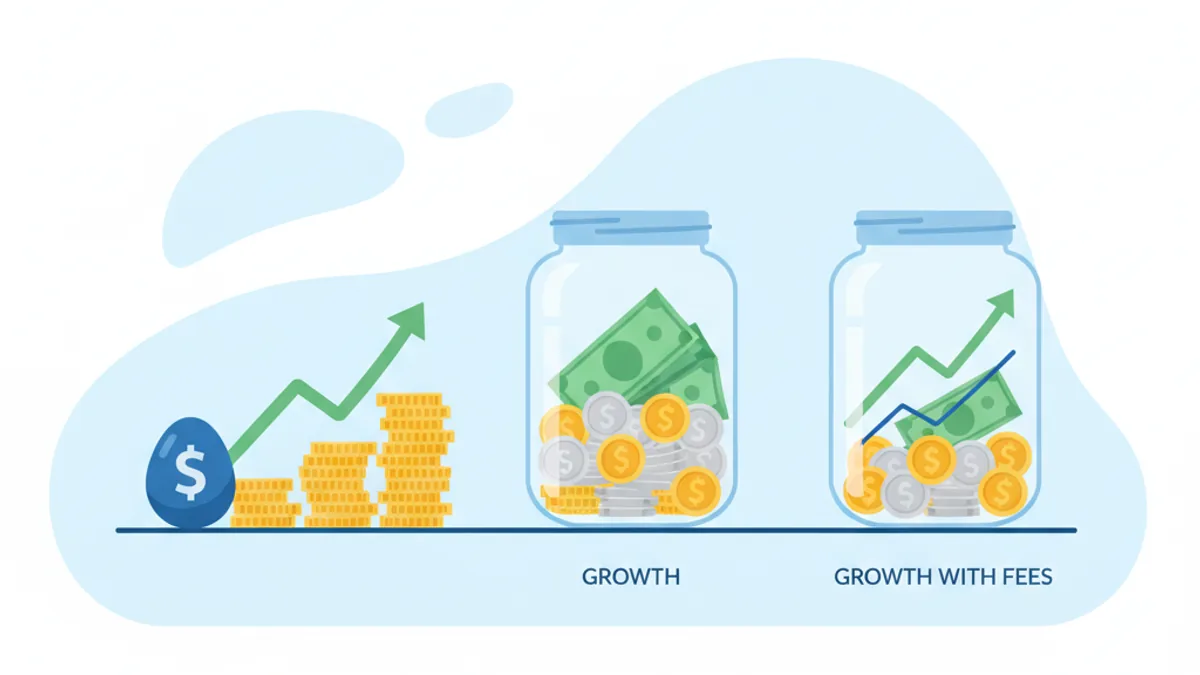
The Fee That Nobody Notices — Until It's Too Late
Super fund fees are one of the most overlooked wealth destroyers in Australia. Not because they're hidden — they're disclosed in every Product Disclosure Statement — but because they look small. A 1.2% annual fee on a $50,000 balance is just $600 a year. Barely noticeable. Except that balance won't stay at $50,000. It'll grow. And the fee will grow with it.
Use our Super Fund Comparison Calculator to see exactly what different fee structures cost you over your working life. The numbers tend to concentrate the mind.
How Fee Drag Actually Works
Super fees work against you in two ways simultaneously. First, they reduce your balance directly each year. Second, the money taken in fees can no longer compound for you — it compounds for the fund instead.
Here's a concrete example. Two people both start at age 30 with $30,000 in super, contributing $500 a month, and both earn an average 7% annual return before fees.
- Person A is in a fund charging 0.5% per year (typical industry super fee)
- Person B is in a fund charging 1.5% per year (typical retail super fee from 10 years ago)
At age 65, Person A has approximately $1,127,000. Person B has approximately $962,000. The fee difference of 1% per year cost Person B over $165,000 — more than five years of contributions. Our Super Balance Growth Calculator lets you model exactly this scenario with your own numbers.
Types of Super Fees You Need to Know
Superannuation funds charge fees in several different ways, which makes direct comparison tricky without knowing what to look for.
Administration Fees
Usually a flat weekly or monthly dollar amount (e.g. $1.50/week) plus a percentage of your balance. The flat fee hurts small balances more; the percentage fee hurts large balances more.
Investment Fees
Charged as a percentage of your investment option's assets. An index option might charge 0.05–0.15%. An actively managed Australian shares option might charge 0.60–0.90%. These are where the biggest differences lurk.
Indirect Cost Ratio (ICR)
Costs deducted from fund assets before the return is calculated — so they don't always appear on your fee statement. They're real costs though, and they're included in the combined fee figure APRA publishes annually.
Buy/Sell Spreads and Switching Fees
Usually minor for long-term investors who don't switch frequently, but worth checking before you change investment options.
What Does a "Good" Fee Look Like?
APRA's 2024 superannuation heatmap data shows that funds charging more than 1.0% total (investment fee + admin fee combined on a $50,000 balance) are consistently underperforming their low-cost peers on net returns. The benchmark for a well-run industry fund on a balanced option is roughly 0.5–0.7% all-in.
For do-it-yourself investors comfortable with index strategies, Self-Managed Super Funds (SMSFs) running ETFs can get total costs below 0.3% — but only above about $300,000 in balance does the SMSF overhead (accounting, audit, ASIC levy) become cost-competitive.
The "Performance Justifies the Fees" Argument
Fund managers sometimes argue that higher fees buy better returns. The data doesn't support this. APRA's Your Future Your Super performance test has consistently shown that higher-fee products are more likely to fail the test, not less. After fees, most actively managed super funds underperform their benchmark index over 10-year rolling periods.
This doesn't mean active management is worthless — it means the after-fee return is what matters, and you need to use a comparison calculator on after-fee numbers, not gross returns.
How to Actually Compare Super Funds
The best starting point is the government's YourSuper comparison tool at moneysmart.gov.au, which uses APRA's standardised data. It compares MySuper products (the default balanced option) on a net-of-fees, net-of-tax basis over 1, 3, 5, and 10 years.
For deeper reading on behavioural finance and why most of us ignore compound costs until it's too late, these Australian personal finance books on Amazon cover the psychology well. Scott Pape's The Barefoot Investor has a particularly clear chapter on super fee traps.
What to Do Right Now
Three actions that take under 30 minutes:
- Log into your super fund's member portal and find your current annual fee as a percentage of balance.
- Run that number through our Retirement Savings Calculator to see your projected balance at retirement.
- Re-run it with a 0.5% lower fee to quantify exactly what switching could be worth to you.
If the number is meaningful — and for most people under 50 it will be — that's the business case for spending an afternoon consolidating accounts and reviewing your fund choice.