Science & Statistics
Quadratic Equation Solver
Solve quadratic equations (ax^2 + bx + c = 0) for roots, discriminant, vertex, and axis of symmetry.
How this calculator works
Applies the quadratic formula: x = (-b +/- sqrt(b^2 - 4ac)) / (2a). Calculates the discriminant to determine root type (real, repeated, or complex). Also computes the vertex at (-b/2a, f(-b/2a)) and the axis of symmetry at x = -b/2a.
Cannot be zero
Our pick

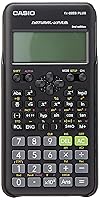
Casio Scientific Calculator
The right calculator makes study sessions faster and less frustrating.
We independently recommend products. We may earn a commission at no extra cost to you.
A solid option for students: the Casio fx-82AU PLUS II Calculator ($27.00, 4.7★ from 259 reviews) is worth a look. Affiliate link
FAQ
Frequently asked questions
What is the quadratic formula?
x = (-b +/- sqrt(b^2 - 4ac)) / 2a. This formula finds the roots (x-intercepts) of any quadratic equation ax^2 + bx + c = 0.
What does the discriminant tell you?
The discriminant (b^2 - 4ac) determines the nature of roots: if positive, there are 2 real roots; if zero, there is 1 repeated real root; if negative, there are 2 complex conjugate roots with no real x-intercepts.
What is the vertex of a parabola?
The vertex is the highest or lowest point of the parabola. Its x-coordinate is -b/(2a) and the y-coordinate is found by substituting this x back into the equation. If a > 0, the vertex is the minimum; if a < 0, it is the maximum.
Related
Related calculators
Scientific Notation Converter
Convert numbers between standard, scientific, and engineering notation.
Open calculatorStandard Deviation Calculator
Calculate mean, median, mode, variance, and standard deviation from a data set.
Open calculatorProbability Calculator
Calculate combined probabilities for independent, dependent, and mutually exclusive events.
Open calculatorPercentage Calculator
Calculate percentages three ways — X% of Y, X is what % of Y, and percentage change between two values.
Open calculator